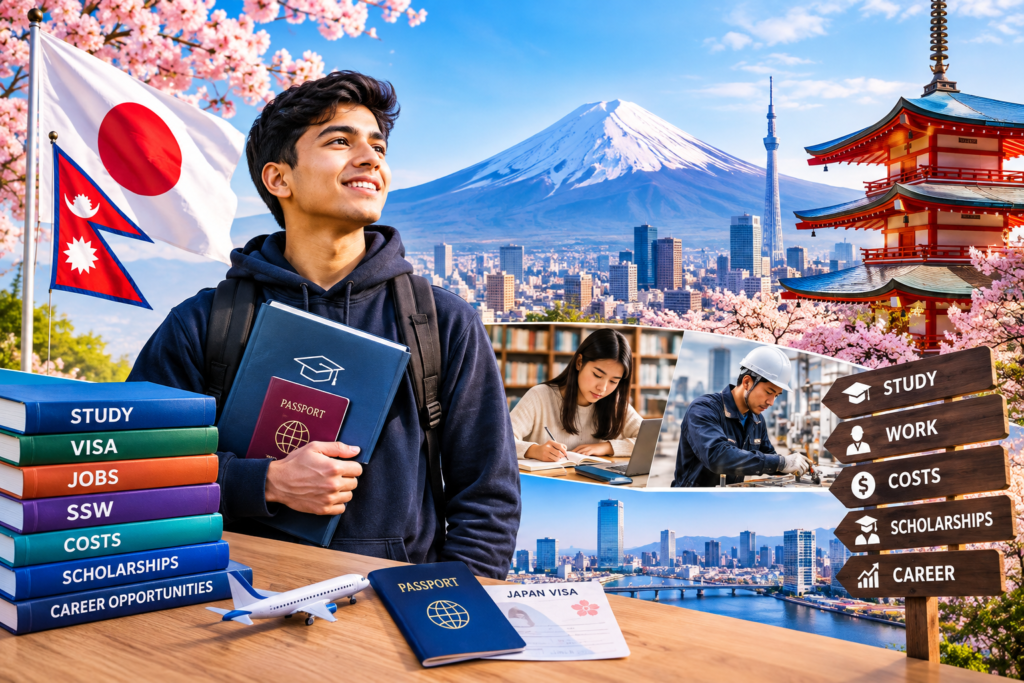
Study and Work in Japan from Nepal: Complete Guide for Nepali Students & Workers to Study, Student Visa, Jobs, SSW, Costs, Scholarships & Career Opportunities.
Study and Work in Japan from Nepal Japan has become an increasingly important destination for Nepali students and workers seeking international education, professional experience and long-term career opportunities. For Nepali citizens, there are several different routes to Japan. These include university and graduate study, Japanese language schools, specialised training colleges, professional employment, and the Specified Skilled Worker (SSW) program. The scale of Nepal-Japan educational mobility is significant. According to Japan’s official 2025 International Student Survey, 100,239 Nepali students were studying in Japan as of May 1, 2025, making Nepal the second-largest source country in the survey after China. The number of Nepali students increased by 54.7% compared with 2024. However, studying or working in Japan should not be approached simply as a way to earn money. Applicants need to understand the appropriate status of residence, admission requirements, Japanese-language expectations, financial requirements, employment rules, visa procedures and long-term career pathway. This guide explains the major routes for study and work in Japan from Nepal, including costs, student visas, scholarships, part-time jobs, SSW, professional work visas and career opportunities. 1. Why Do Nepali Students Choose Japan? Japan offers a combination of higher education, vocational training, technology, manufacturing, services and employment opportunities. Some major reasons Nepali students consider Japan include: High-quality universities and colleges Japanese language education Technical and vocational education Opportunities to gain international work experience Scholarships and tuition-support programs Demand for workers in selected sectors Opportunities to transition from study to employment Strong transportation and infrastructure Exposure to Japanese technology and business culture Opportunities to develop Japanese-language skills The growing Nepali student population is evidence of the importance of Japan as an education destination. In 2025, Japan recorded 408,069 international students overall, including 100,239 students from Nepal. 2. Main Routes to Study and Work in Japan from Nepal There is no single “Japan visa” that covers every situation. The correct route depends on your purpose. Route Main Purpose & Typical Status/Route University Bachelor’s degree — Student Graduate school Master’s/PhD — Student Japanese language school Japanese-language preparation — Student Specialized training college Practical/vocational education — Student Professional employment Skilled professional job — Work status SSW Specified skilled employment — Specified Skilled Worker MEXT Government-funded study — Student Part-time work Supplementary employment while studying — Permission under Student status The Student status of residence is for studying at universities, junior colleges, colleges of technology, specialised training colleges, and Japanese language schools. The permitted period of stay can be up to 4 years and 3 months, depending on the circumstances. 3. Study in Japan from Nepal Nepali students can pursue several types of education in Japan. 3.1 Bachelor’s Degree Students who have completed the required level of secondary education can apply to Japanese universities. Depending on the university and program, admission may involve: Academic transcripts Graduation certificates Entrance examinations Interviews English-language test results Japanese-language qualifications EJU Financial documentation Statement of purpose Recommendation letters Requirements vary significantly between institutions, so students should always check the specific university’s current admission guidelines. Japan’s official Study in Japan portal specifically notes that application materials and entrance examinations vary from school to school. 4. Master’s and PhD Studies in Japan Japan is also an option for Nepali graduates seeking postgraduate education. Potential areas include: Engineering Information technology Artificial intelligence Business Economics International relations Environmental science Biotechnology Agriculture Public health Architecture Robotics Japanese studies Social sciences For postgraduate applicants, academic background and the relationship between previous study and the proposed research are particularly important. Some programs are delivered completely in English. Japan’s official Study in Japan database includes English-based degree programs, including graduate programs. Therefore, Japanese proficiency is not automatically required for every degree program. 5. Japanese Language School Route Another common pathway is: Nepal → Japanese language school → higher education or employment Students may attend a Japanese language institution to improve their language ability before entering: University Graduate school Specialised training college Employment pathway This route can be useful for students who intend to study or work primarily in Japanese. However, students should carefully evaluate: School accreditation/status Course duration Attendance requirements Tuition Accommodation Progression options Employment support Refund policies Financial requirements A language school should not be selected solely because an agent promises that it will automatically lead to a job. 6. Japanese Language Requirements for Nepali Students Japanese-language requirements depend on the intended course. For an English-taught degree, Japanese may not be required. For Japanese-medium education, significantly stronger Japanese proficiency is normally expected. Japan’s official Study in Japan guidance gives JLPT N2 and an EJU score of 250 excluding writing as a guideline for university programs taught in Japanese or Japanese and English, although individual institutions can establish their own requirements. For students planning employment in Japan, Japanese ability can become even more important. Common benchmarks include: N5: Basic beginner level N4: Elementary Japanese N3: Intermediate level N2: Upper-intermediate level N1: Advanced level The required level depends on the occupation and employer. For SSW, the official program generally requires either JFT-Basic or JLPT N4 or higher, together with the relevant skills test. Some occupations have higher Japanese requirements; for example, automobile transportation and railway train-operation work require JLPT N3 or higher. 7. Japan Student Visa from Nepal A student normally needs the appropriate Japanese Student status of residence and an entry visa. A typical pathway is: Choose institution → Apply for admission → Receive acceptance → School/representative applies for COE → Obtain COE → Apply for visa → Travel to Japan → Complete residence procedures What is a COE? COE means Certificate of Eligibility. For students, the accepting educational institution commonly acts as the applicant’s proxy for the COE application at a regional immigration services bureau in Japan. The COE is an important part of the immigration process, but receiving a COE does not mean students should ignore the separate visa application requirements. 8. Japan Student Visa Requirements from Nepal Exact requirements can change according to the applicant, institution and immigration circumstances. Common documentation may include: Valid passport Visa application form Photograph Certificate of Eligibility Admission/acceptance