
Tourist Visa for Nepali Citizens: Complete Guide to Requirements, Documents, Application, Costs and Travel Rules
Tourist Visa for Nepali Citizens
A Tourist Visa is a temporary immigration permission that allows a traveler to enter another country for permitted short-term purposes such as tourism, holidays, sightseeing, visiting friends or relatives, and other activities specifically allowed under that country’s visitor-visa rules.
For Nepali citizens, there is no single worldwide “Tourist Visa.” The exact visa category, eligibility requirements, documents, fees, application process, financial requirements, interview procedures, permitted activities and length of stay depend on the country the traveler intends to visit.
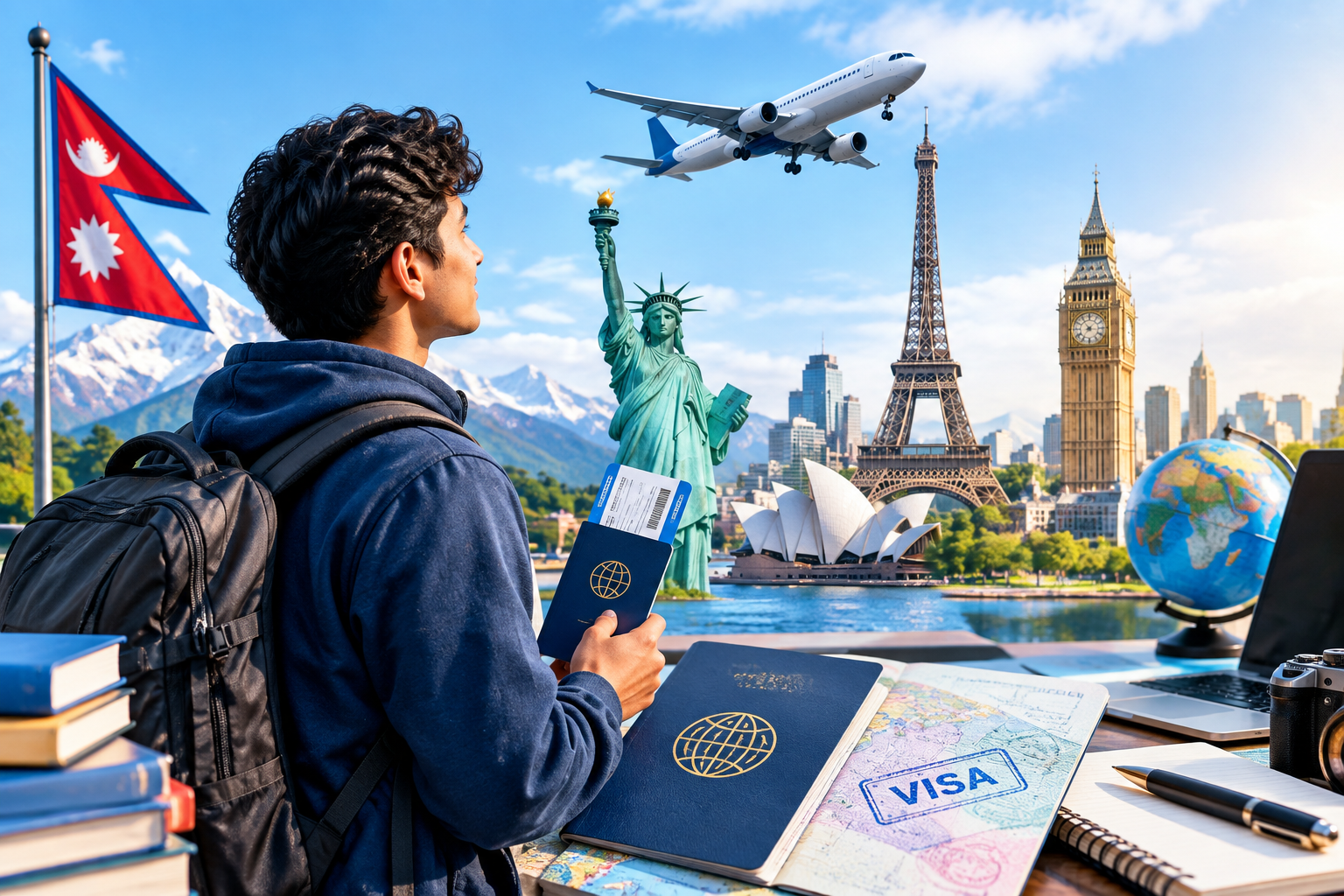
For example, the United States generally uses the B-2 or combined B-1/B-2 visitor visa for tourism and temporary visits; the United Kingdom uses the Standard Visitor route; Australia uses the Visitor visa framework, including Subclass 600; Canada uses the visitor visa, also called a Temporary Resident Visa; and countries in the Schengen Area use the Schengen short-stay visa system.
For Nepali travellers, the process also involves an important second layer: Nepal’s own departure and immigration requirements. Having a foreign tourist or visit visa does not automatically mean that a traveler can leave Nepal without presenting the documents required by Nepali immigration authorities.
This guide explains the Tourist Visa process from a Nepal-focused perspective and separates:
- What a Tourist Visa means
- Who generally needs one
- Tourist Visa eligibility
- Required documents
- Financial evidence
- Sponsorship
- Hotel and travel arrangements
- Application procedures
- Biometrics and interviews
- Tourist Visa fees
- Processing time
- Common rejection factors
- Requirements for students
- Requirements for employed applicants
- Requirements for self-employed applicants
- Requirements for sponsored travelers
- Nepal departure requirements
- Country-specific examples
- Tourist Visa versus Study and Work Visa
- Pre-departure checklist
- Frequently asked questions
Important: Visa rules are country-specific and can change. Applicants should verify the current requirements on the official immigration, embassy, consular or government website of the destination country before submitting an application.
1. What Is a Tourist Visa?
A Tourist Visa is a temporary visa or visitor permission intended for eligible short-term travel.
Depending on the destination, permitted activities may include:
- Tourism
- Sightseeing
- Holidays
- Visiting friends
- Visiting relatives
- Short recreational activities
- Certain cultural activities
- Certain business-visitor activities
- Medical treatment where specifically permitted
- Transit-related activities where applicable
The exact activities allowed depend on the destination country’s immigration law.
For example, the U.S. Department of State states that visitor visas can cover tourism, vacation, visiting friends or relatives and certain medical-treatment purposes, while employment and ordinary academic study are not permitted on a visitor visa.
The UK Standard Visitor route allows tourism, visiting family or friends and certain other permitted activities, generally for visits of up to six months.
Australia’s Visitor visa Subclass 600 Tourist stream is designed for tourism, visiting family and friends and related temporary visitor activities.
Therefore, a Tourist Visa should not be understood simply as a document that allows a person to enter a foreign country for any purpose.
The purpose of travel must match the visa category.
2. Tourist Visa for Nepali Citizens
Nepali citizens who want to travel abroad for tourism or to visit friends and family may need to obtain a visa before travelling, depending on the destination.
Nepali citizens generally travel internationally using a valid Nepali passport and, where required, a valid visa for the destination country.
The Tribhuvan International Airport Immigration Office states that Nepali citizens traveling abroad for tourism or visits should be prepared to present a valid passport and visa, a two-way air ticket, hotel booking, sponsor information and financial evidence, along with other documents when required.
The same government source states that Nepali nationals traveling abroad need a valid Nepali passport and destination visa except where the destination permits Visa on Arrival or another applicable entry arrangement.
This creates two separate responsibilities:
Before traveling
The traveler must satisfy the destination country’s immigration requirements.
At Nepal’s departure immigration
The traveller must also satisfy Nepal’s departure requirements.
This distinction is extremely important for first-time travellers.
3. Tourist Visa vs Visit Visa
The terms Tourist Visa and Visit Visa are often used interchangeably in everyday conversation.
However, immigration systems may define them differently.
A destination may use terms such as:
- Visitor Visa
- Tourist Visa
- Standard Visitor Visa
- Temporary Resident Visa
- Short-Stay Visa
- Schengen Visa
- Visitor Permit
- Electronic Travel Authorization
The terminology does not necessarily determine the exact rights attached to the visa.
The applicant must read the official rules of the destination country.
For example:
- Canada calls its visitor document a Visitor Visa, also known as a Temporary Resident Visa.
- The UK uses the Standard Visitor route.
- Australia uses the Visitor visa (Subclass 600) for several visitor streams.
- The United States uses B-2 or B-1/B-2 visitor visas for tourism and certain temporary visits.
- Schengen countries use a short-stay visa for visits of up to 90 days in a 180-day period.
4. Who Can Apply for a Tourist Visa?
A Nepali citizen may apply for a tourist or visitor visa when the destination country’s immigration rules provide such a route and the applicant can demonstrate that the proposed trip is consistent with the requirements.
Typical applicants include:
- Students
- Employees
- Business owners
- Professionals
- Self-employed individuals
- Retired people
- Families
- Parents
- First-time travelers
- Travelers visiting friends
- Travelers visiting relatives
- Tourists traveling independently
- Travelers joining organized tours
Being a student, employee or business owner does not automatically guarantee visa approval.
Similarly, not having a previous international travel history does not automatically mean that an applicant cannot qualify.
The destination country evaluates the application according to its own immigration rules.
5. Basic Tourist Visa Eligibility
Although requirements differ by country, visitor visa applications commonly examine several areas.
5.1 Genuine Temporary Purpose
The applicant should have a legitimate temporary reason for traveling.
Examples include:
- Vacation
- Tourism
- Visiting relatives
- Visiting friends
- Attending permitted events
- Short recreational activities
- Other activities allowed by the visitor category
The applicant should be able to explain:
- Why they want to travel
- Where they will travel
- How long they intend to stay
- Where they will stay
- Who will pay for the trip
- What they intend to do during the visit
- Why they will return or comply with the destination’s immigration conditions
Australia explicitly identifies being a genuine visitor as a basic eligibility requirement for its Visitor visa.
The UK similarly requires applicants to demonstrate that they will leave the UK at the end of their visit and that they can support themselves or have appropriate financial support.
6. Passport Requirements
A valid passport is one of the fundamental documents for international travel.
Before applying, check:
- Passport validity
- Blank pages where required
- Passport condition
- Previous passports
- Previous visas
- Immigration stamps
- Previous refusals
- Name consistency
- Date-of-birth consistency
Some countries impose specific validity requirements.
For example, Canada’s visitor visa application guidance states that applicants should provide a valid passport or travel document and notes a six-month validity recommendation in its application instructions.
Schengen requirements specify that the passport should remain valid for at least three months after departure from the Schengen area, subject to the applicable rules.
Therefore, applicants should not rely on a generic “six-month rule” for every country.
7. Tourist Visa Application Documents
There is no universal document list for every destination.
However, commonly requested documents may include:
Identity documents
- Valid passport
- Previous passports
- Passport photographs
- National identity documents where required
- Birth certificate where relevant
- Marriage certificate where relevant
Travel documents
- Travel itinerary
- Proposed flight itinerary
- Return or onward travel evidence
- Hotel reservation
- Accommodation details
- Tour booking
- Invitation letter where applicable
Financial documents
- Bank statements
- Bank balance certificate
- Income evidence
- Salary certificate
- Employment letter
- Tax documents
- Business financial records
- Sponsor financial evidence
Personal circumstances
- Employment evidence
- Business registration
- Student enrollment
- Leave approval
- Family information
- Property or other lawful economic ties where relevant
Additional documents
Depending on destination:
- Travel insurance
- Invitation letter
- Sponsor letter
- Relationship documents
- Medical documents
- Biometric information
- Police certificates
- Previous travel history
- Additional forms
Applicants should submit documents specifically required by their destination rather than unnecessarily submitting large quantities of unrelated paperwork.
8. Financial Requirements for a Tourist Visa
Financial evidence is one of the most important parts of many visitor visa applications.
The purpose is generally to demonstrate that the applicant has access to sufficient funds to cover the proposed trip or has an acceptable source of financial support.
Possible financial evidence includes:
- Personal bank statements
- Bank balance certificates
- Salary slips
- Employment income
- Business income
- Tax records
- Sponsor bank statements
- Scholarship or institutional funding where relevant
- Other lawful sources of funds
However, there is no universal bank balance amount that guarantees a Tourist Visa.
A reasonable financial assessment should consider:
- Trip duration
- Destination
- Accommodation
- Airfare
- Daily expenses
- Number of travelers
- Existing financial obligations
- Source of income
- Sponsor arrangements
For example, an applicant planning a five-day trip should not necessarily demonstrate the same financial capacity as a person planning a two-month trip.
The evidence should be credible and consistent with the proposed itinerary.
9. Bank Statement for Tourist Visa
A bank statement can help demonstrate:
- Available funds
- Regular income
- Financial history
- Transaction patterns
- Source of funds
- Ability to finance the proposed journey
Applicants should avoid presenting financial documents that are inconsistent with their circumstances.
Examples of potential concerns can include:
- Unexplained large deposits
- Sudden unexplained transfers
- Borrowed money presented as personal savings
- Contradictory income information
- Financial documents that do not match the stated occupation
- Documents that cannot be verified
The exact requirements differ by destination.
A strong application is not necessarily the application showing the largest bank balance. The financial evidence should be genuine, explainable and consistent with the applicant’s circumstances and travel plan.
10. Tourist Visa Sponsorship
A traveler may sometimes be financially supported by:
- Parents
- Spouse
- Children
- Relatives
- Friends
- Employers
- Organizations
- Other permitted sponsors
Depending on the destination, the applicant may need:
- Sponsor letter
- Sponsor identification
- Proof of relationship
- Sponsor bank statements
- Sponsor income evidence
- Accommodation evidence
- Evidence explaining the sponsor’s responsibility
The sponsor’s relationship to the applicant should be clearly documented.
For example, if parents are funding a student’s holiday, the application may need to explain:
- Who the parents are
- Their occupations
- Their income
- Their relationship to the student
- Why they are funding the trip
- The expected cost
- How the student will return to Nepal
11. Tourist Visa Requirements for Students
Students represent an important category of Nepali Tourist Visa applicants.
A student may travel abroad during:
- Semester breaks
- University holidays
- School holidays
- Academic vacations
- Family visits
- Personal holidays
A student application may benefit from evidence such as:
- Current student enrollment
- Student ID
- University or college letter
- Academic calendar
- Leave approval where applicable
- Parent sponsorship
- Parent income evidence
- Bank statements
- Travel itinerary
- Accommodation documents
The applicant should clearly distinguish a temporary tourist trip from an intention to study abroad.
A Tourist Visa should not be used as a substitute for a Study Visa when the intended activity requires a student visa.
The United States, for example, explicitly lists study among activities that are not permitted on a visitor visa.
12. Tourist Visa Requirements for Employed Applicants
An employed applicant may provide:
- Employment letter
- Salary certificate
- Approved leave letter
- Employment contract
- Bank statements
- Tax documents
- Company identification
- Travel itinerary
An employment letter can establish information such as:
- Position
- Start date
- Salary
- Employment status
- Approved vacation period
- Expected return to employment
The purpose is not to create artificial “ties,” but to provide accurate evidence of the applicant’s real circumstances.
13. Tourist Visa Requirements for Business Owners
Business owners may need documents such as:
- Company registration
- PAN/VAT documentation
- Business bank statements
- Tax clearance
- Business ownership documents
- Company profile
- Income evidence
- Leave or travel explanation where applicable
The documentation should demonstrate the actual business situation.
A business owner should avoid creating documents solely for visa purposes.
14. Tourist Visa for Visiting Friends or Relatives
A traveler visiting someone abroad may need:
- Invitation letter
- Host’s passport or identity document
- Host’s immigration status
- Proof of address
- Relationship evidence
- Accommodation information
- Sponsor evidence where applicable
If the traveler is visiting a family member, documents establishing the relationship may be useful or required.
For example:
- Birth certificate
- Marriage certificate
- Family relationship certificate
- Other government-issued relationship evidence
The applicant should accurately state whether they will stay in a hotel or with the host.
15. Tourist Visa Invitation Letter
An invitation letter may include:
- Host’s full name
- Address
- Contact information
- Immigration status
- Relationship with traveler
- Purpose of visit
- Intended dates
- Accommodation arrangement
- Financial responsibility, if applicable
However, an invitation letter does not automatically guarantee visa approval.
The applicant still needs to satisfy the destination country’s requirements.
16. Hotel Booking for Tourist Visa
Accommodation evidence can demonstrate where the traveler plans to stay.
Possible evidence includes:
- Hotel reservation
- Accommodation booking
- Host address
- Invitation letter
- Tour package
- Other acceptable accommodation evidence
The accommodation should correspond with the itinerary.
For example, if the application says the traveler will visit Paris for five days, the accommodation evidence should reasonably cover the intended stay.
17. Travel Itinerary
A travel itinerary explains the planned journey.
It may include:
| Information | Example |
|---|---|
| Destination | London |
| Duration | 7 days |
| Arrival | Day 1 |
| Accommodation | Hotel |
| Activities | Sightseeing |
| Departure | Day 7 |
| Return destination | Nepal |
A good itinerary should be realistic.
Applicants should avoid creating excessively complicated itineraries that cannot reasonably be completed.
18. Return Air Ticket and Travel Plans
Some visa applications require evidence of onward or return travel, while others may advise applicants not to purchase non-refundable tickets before visa issuance.
This distinction matters.
The U.S. Department of State specifically advises applicants not to make final travel plans or purchase tickets until the visa has been issued.
Therefore, applicants should follow the instructions of the destination country rather than assuming that a paid return ticket is always required.
For Nepal’s departure immigration, however, the current Tribhuvan International Airport information states that Nepali citizens travelling for tourism or visits should present a two-way air ticket.
19. Tourist Visa Travel Insurance
Travel insurance is required or recommended by some destinations.
For Schengen applications, medical travel insurance is among the listed requirements. The European Commission states that applicants need medical insurance covering emergency medical care, hospitalization and repatriation under the applicable Schengen rules.
Travel insurance can potentially cover:
- Emergency medical expenses
- Hospitalization
- Emergency evacuation
- Repatriation
- Trip interruption
- Lost baggage
The required coverage and minimum amount depend on the destination.
20. Tourist Visa Biometrics
Some countries require applicants to provide biometric information.
Biometrics may include:
- Fingerprints
- Digital photograph
- Other identity verification
The exact procedure depends on the destination country’s visa system.
Canada, for example, states that applicants may need to provide biometrics and that biometric processing time can affect overall processing time.
Applicants should attend biometric appointments with the required documents and follow the visa center’s instructions.
21. Tourist Visa Interview
Some countries may require a visa interview or interview-like assessment.
Questions can concern:
- Purpose of travel
- Travel dates
- Destination
- Occupation
- Income
- Sponsor
- Family
- Previous travel
- Accommodation
- Trip expenses
- Return plans
Applicants should answer truthfully and directly.
There is no legitimate universal “magic answer” that guarantees a Tourist Visa.
The safest approach is to ensure that:
- The application is truthful.
- Documents are genuine.
- Answers are consistent.
- The applicant understands their itinerary.
- Financial information is explainable.
22. Tourist Visa Interview Questions
Common interview topics may include:
Purpose
- Why are you traveling?
- Why did you choose this destination?
- What places will you visit?
Duration
- How long will you stay?
- When will you return?
Financial
- Who is paying for your trip?
- What is your source of income?
- How much will the trip cost?
Employment or education
- Where do you work?
- What do you study?
- How long have you worked there?
- When does your leave end?
Accommodation
- Where will you stay?
- Who arranged the accommodation?
- Are you staying with family or friends?
Travel history
- Have you traveled internationally before?
- Have you previously received a visa?
- Have you ever been refused a visa?
Applicants should never invent answers to make their circumstances appear stronger.
23. Tourist Visa Processing Time
Processing time varies significantly.
It can depend on:
- Destination
- Visa category
- Application volume
- Completeness of application
- Biometrics
- Interview requirements
- Security checks
- Background verification
- Requests for additional documents
Canada states that processing times vary according to application type, completeness, verification requirements and other factors.
Australia similarly directs applicants to its processing-time guide and notes that the displayed processing information is only an indication.
Therefore, applicants should avoid relying on unofficial claims such as:
“Tourist Visa always takes exactly 15 days.”
There is no universal processing time.
24. Tourist Visa Fees
Tourist Visa fees depend on the destination and visa type.
Examples illustrate why applicants should check the official destination authority:
Canada
Canada lists the visitor visa fee starting from CAD 100, with additional costs potentially applicable for biometrics.
United Kingdom
The UK Standard Visitor visa page currently lists £135 for a visit of up to six months.
Australia
Australia lists the Visitor visa Subclass 600 Tourist stream from AUD 250 for applications made outside Australia.
United States
U.S. visa fees are published by the U.S. Department of State and can depend on visa category and applicable reciprocity arrangements.
Schengen Area
Schengen visa fees are governed under EU visa rules and applicants should verify the current fee applicable to their circumstances.
Fees can change, so this article should not be treated as a permanent fee table.
25. Tourist Visa for the United States
The United States generally uses the B-2 visitor visa for tourism and certain temporary visits, with B-1/B-2 combining business and tourism purposes.
Permitted B-2 activities can include:
- Tourism
- Vacation
- Visiting friends
- Visiting relatives
- Certain medical treatment
- Certain social activities
The U.S. Department of State explicitly states that visitor visas do not permit ordinary employment or study.
A Nepali applicant should therefore prepare evidence that matches the temporary purpose of the proposed visit.
26. Tourist Visa for Canada
Canada refers to its visitor visa as a Visitor Visa, also called a Temporary Resident Visa.
The official Canadian government explains that the visa demonstrates that the applicant meets the requirements necessary to travel to Canada.
Applicants should review:
- Eligibility
- Passport requirements
- Financial evidence
- Purpose of travel
- Biometrics
- Supporting documents
- Application process
- Processing information
Canada’s official application guidance states that the reason for travel affects the application and documents required.
27. Tourist Visa for the United Kingdom
The UK uses the Standard Visitor route.
The UK government states that Standard Visitors can generally stay for up to six months and may visit for tourism, visiting family or friends and other permitted activities.
Applicants must demonstrate, among other things, that:
- The visit is permitted.
- They will leave at the end of the visit.
- They can support themselves or have appropriate financial support.
- They can pay for return or onward travel.
- They will not use repeated visits to effectively live in the UK.
28. Tourist Visa for Australia
Australia’s Visitor visa Subclass 600 includes a Tourist stream for applicants outside Australia.
The Australian Department of Home Affairs states that the Tourist stream is intended for tourism, cruises and visiting family or friends. It also requires applicants to be genuine visitors with enough funds to support their stay and leave Australia.
Applicants should check:
- Correct stream
- Eligibility
- Financial requirements
- Passport requirements
- Supporting documents
- Processing guidance
- Visa conditions
29. Schengen Tourist Visa
A Schengen short-stay visa permits eligible non-EU nationals to make a temporary visit of up to 90 days in any 180-day period, subject to the applicable rules.
The Schengen system includes:
- Single-entry visa
- Multiple-entry visa
- Airport transit visa
The European Commission advises applicants visiting multiple Schengen countries to apply through the consulate responsible for their main destination; where stays are equal, the first country visited generally determines the application location.
Applicants may need:
- Passport
- Application form
- Photograph
- Travel medical insurance
- Financial evidence
- Accommodation information
- Travel itinerary
- Other supporting documentation
Applications generally must be submitted no earlier than six months and at least 15 days before the intended journey, subject to applicable exceptions and appointment availability.
30. Tourist Visa for Japan
Japan’s visitor visa requirements depend on nationality, purpose, travel arrangements and current Japanese immigration/consular rules.
Nepali applicants should use the official Japanese Embassy/consular information applicable to Nepal rather than relying on third-party lists.
Typical areas of documentation may include:
- Passport
- Visa application
- Photograph
- Travel itinerary
- Accommodation
- Financial evidence
- Employment or education evidence
- Invitation documents where applicable
Requirements can differ depending on whether the applicant is traveling independently or visiting a person or organization.
31. Tourist Visa and Nepal Departure Immigration
Obtaining a foreign Tourist Visa is not the end of the process.
Nepali citizens departing Nepal may need to show documents to Nepal’s immigration authorities.
The current Tribhuvan International Airport Immigration Office lists the following for Nepali citizens traveling for tourism or visits:
- Valid passport
- Visa clarifying the purpose of travel
- Two-way air ticket
- Hotel booking
- Sponsor letter from an individual or institution
- USD 500 cash/dollar or equivalent foreign currency with the authorized bank stamp/seal
The same page says other documents may also be requested.
This is important because older online articles may contain different financial figures.
A June 2026 Government of Nepal notice available through the immigration system contains a different documentary formulation for visit-visa departures, referring to a sponsor letter or foreign currency equivalent to USD 1,000 together with hotel reservation and other travel evidence.
Because official sources currently display differing figures, travelers should confirm the exact departure requirement with the relevant Nepal immigration office immediately before travel, rather than relying on an old blog or social-media post.
32. Important Nepal Departure Checklist
Before going to the airport, a Nepali tourist traveler should organize:
- Valid Nepali passport
- Valid destination visa, where required
- Boarding pass
- Two-way ticket
- Hotel/accommodation evidence
- Sponsor letter, where applicable
- Financial evidence
- Bank-stamped foreign-currency documentation where required
- Travel itinerary
- Invitation letter where applicable
- Relationship documents if visiting relatives
- Additional destination-country documents
- Travel insurance where required
Nepal’s immigration authority may request additional information or documents.
33. Tourist Visa for Visiting a Spouse Abroad
Nepal’s airport immigration guidance specifically identifies a situation involving Nepali travelers visiting a spouse working in Gulf countries.
The current guidance says the traveler should produce a recommendation letter issued by the concerned Nepalese Embassy verifying that the spouse has invited the traveler.
This illustrates why applicants should distinguish:
- Ordinary tourism
- Visiting relatives
- Visiting a spouse
- Sponsored travel
- Foreign employment-related travel
The documentation may differ.
34. Tourist Visa for Minors
Children traveling internationally may require additional documentation.
Depending on circumstances, documents may include:
- Child’s passport
- Visa
- Birth certificate
- Parent’s passport
- Consent letter
- Custody documentation where applicable
- Airline authorization
- Sponsor documentation
Nepal immigration guidance states that additional documentation may be required when a minor travels alone or with someone other than a parent/guardian.
Parents should check both:
- Destination-country rules
- Airline and Nepal departure requirements
35. Tourist Visa Rejection
A visa refusal can occur for different reasons depending on the destination’s immigration law.
Possible areas of concern can include:
- Unclear purpose of travel
- Insufficient or unexplained finances
- Inconsistent documents
- Contradictory information
- Inability to establish eligibility
- Inadequate evidence
- Misrepresentation
- Previous immigration violations
- Failure to meet specific destination requirements
A refusal does not necessarily mean that every future application will be refused.
Applicants should read the official refusal explanation where provided and address the actual issue rather than simply submitting the same application again.
36. Common Tourist Visa Mistakes
Mistake 1: Showing unexplained deposits
Large unexplained deposits can create questions about the source of funds.
Mistake 2: Fake documents
False bank statements, employment letters or bookings can create serious immigration problems.
Mistake 3: Inconsistent information
The application, interview and supporting documents should not contradict one another.
Mistake 4: Wrong visa category
A person intending to study or work should not use a tourist category when the destination requires a study or work visa.
Mistake 5: Unrealistic itinerary
The proposed travel should be logically possible.
Mistake 6: Ignoring Nepal departure rules
Having a visa does not eliminate Nepal’s own immigration requirements.
Mistake 7: Relying entirely on agents
Applicants should independently understand their own application.
Mistake 8: Using outdated information
Visa rules, fees and procedures can change.
37. Tourist Visa vs Study Visa vs Work Visa
| Feature | Details |
|---|---|
| Main purpose | Tourist Visa: Tourism/visit • Study Visa: Education • Work Visa: Employment |
| Tourism | Tourist Visa: Usually permitted • Study Visa: Depends on conditions • Work Visa: Depends on conditions |
| Formal study | Tourist Visa: Generally restricted • Study Visa: Main purpose • Work Visa: Depends on conditions |
| Employment | Tourist Visa: Generally prohibited • Study Visa: Usually restricted • Work Visa: Main purpose |
| Job offer | Tourist Visa: Usually not required • Study Visa: Usually not required • Work Visa: Often required |
| Admission letter | Tourist Visa: Usually not required • Study Visa: Usually required • Work Visa: Not normally |
| Employment contract | Tourist Visa: Usually not required • Study Visa: Not normally • Work Visa: Often required |
| Duration | Tourist Visa: Usually temporary • Study Visa: Course-related • Work Visa: Employment-related |
| Financial evidence | Tourist Visa: Common • Study Visa: Common • Work Visa: Depends on route |
| Sponsor | Tourist Visa: Sometimes • Study Visa: Sometimes • Work Visa: Employer may sponsor |
| Main objective | Tourist Visa: Temporary visit • Study Visa: Education • Work Visa: Employment |
| Important note | Exact rules are destination-specific. For example, U.S. visitor visas generally do not permit ordinary employment or formal study. |
38. Tourist Visa vs Study Abroad
A student planning a short holiday abroad and a student planning to enroll in a foreign university have different immigration purposes.
Tourist purpose
The traveler intends to:
- Visit
- Sightsee
- Take a holiday
- Return to Nepal
Study purpose
The traveler intends to:
- Enroll in an academic program
- Attend classes
- Complete a qualification
- Remain for an education period
The second situation normally requires an appropriate study visa or permission.
Applicants should never assume that entering a country as a tourist automatically gives them permission to study.
39. Tourist Visa vs Work Visa
Tourist status and work authorization are fundamentally different.
A person traveling for tourism normally cannot simply begin employment.
Work visas can require:
- Employer sponsorship
- Work authorization
- Labour approval
- Employment contract
- Occupation eligibility
- Salary requirements
- Skills assessment
- Employer documentation
The exact requirements depend on the destination.
Therefore:
Tourist Visa = temporary visitor purpose
Work Visa = employment purpose
40. How to Apply for a Tourist Visa
A general application workflow is:
Step 1: Select destination
Identify the exact country.
Step 2: Identify the correct visa
Check whether the country uses:
- Tourist Visa
- Visitor Visa
- Standard Visitor
- Short-Stay Visa
- Electronic authorization
- Visa-free entry
- Visa on Arrival
Step 3: Read official requirements
Use the government’s official immigration or embassy website.
Step 4: Prepare documents
Prepare identity, financial, employment/education and travel documents.
Step 5: Complete the application
Enter information exactly as shown on official documents.
Step 6: Pay the applicable fee
Pay through the authorized channel.
Step 7: Biometrics
Provide biometrics where required.
Step 8: Interview
Attend an interview if required.
Step 9: Wait for decision
Monitor the official application system.
Step 10: Check the visa
Verify:
- Name
- Passport number
- Visa type
- Validity
- Number of entries
- Conditions
- Duration
Step 11: Prepare for departure
Organise Nepal’s departure documents.
41. How to Prepare a Strong Tourist Visa File
A well-prepared file should tell a consistent story.
Think of the application as a chain:
Identity → Purpose → Finances → Accommodation → Travel plan → Temporary stay → Compliance
For example:
A student:
College enrollment → vacation period → parents sponsor → bank evidence → hotel booking → seven-day itinerary → return to Nepal
An employee:
Employment → approved leave → personal savings → hotel → tourism itinerary → return to employment
A business owner:
Business ownership → business income → personal/company financial evidence → holiday itinerary → return to business
The exact evidence required depends on the destination.
42. Tourist Visa Document Checklist for Nepali Applicants
Basic Documents
- Valid passport
- Visa application form
- Recent passport photograph
- Previous passport, where applicable
- Previous visas, where applicable
Financial Documents
- Bank statements
- Bank balance evidence
- Income evidence
- Salary slips
- Tax documents
- Sponsor’s financial documents, if applicable
Employment Documents
- Employment letter
- Leave approval letter
- Salary certificate
- Employment contract, if relevant
Student Documents
- Student ID
- Enrollment letter
- Academic calendar
- Parent sponsorship documents, where applicable
Business Documents
- Company registration documents
- PAN/VAT documents
- Tax documents
- Business bank statements/evidence
- Business income evidence
Travel Documents
- Travel itinerary
- Accommodation booking/evidence
- Flight booking or ticket evidence
- Invitation letter, where applicable
- Travel insurance, where required
Nepal Departure Documents
- Valid passport
- Valid destination-country visa
- Two-way/return ticket
- Accommodation evidence
- Sponsor documentation, if applicable
- Required financial or foreign-currency evidence
43. Tourist Visa Application: What Applicants Should Never Do
Applicants should not:
- Submit fake documents
- Modify bank statements
- Hide previous refusals where disclosure is required
- Invent employment
- Invent travel history
- Misrepresent the purpose of travel
- Purchase fraudulent bookings
- Use a fake invitation letter
- Provide false financial information
- Claim to be employed when unemployed
- Claim to be a student when not enrolled
- Use a Tourist Visa to perform unauthorised employment
False information can create much more serious consequences than an ordinary visa refusal.
44. Tourist Visa and Previous Travel History
Previous international travel can be relevant to an application, but there is no universal rule that a person must have traveled to other countries before obtaining a Tourist Visa.
A first-time traveler should instead focus on providing:
- Genuine purpose
- Accurate documentation
- Realistic itinerary
- Financial evidence
- Correct visa category
- Honest answers
- Evidence required by the destination
Applicants should never create fake travel history.
45. Tourist Visa and Immigration Compliance
A visitor should follow all conditions attached to the visa.
Possible conditions can include:
- Maximum stay
- No employment
- No unauthorized study
- No public benefits
- No unauthorized business activity
- Departure before visa/status expiry
The traveler is responsible for understanding the conditions attached to their specific visa.
For example, the U.S. Department of State expressly states that B-1/B-2 visitors are not permitted to accept employment in the United States.
46. Can a Tourist Visa Be Extended?
Sometimes.
The possibility of extending a visitor status depends entirely on the destination country’s immigration rules.
Some countries allow extensions under specific circumstances.
Others require the traveler to leave before the authorized stay expires.
A visa’s expiration date and the authorized period of stay are not necessarily the same concept.
Applicants should always distinguish:
Visa validity
from
authorized period of stay.
47. Visa Validity vs Length of Stay
Suppose a visa is valid for several years.
That does not necessarily mean the traveler can remain in the destination country continuously for that entire period.
The visa may allow repeated entry, while immigration authorities determine the permitted stay during each entry.
This distinction is particularly important for countries offering multiple-entry visitor visas.
48. Tourist Visa and Multiple Entry
A multiple-entry Tourist Visa may allow a traveler to request entry multiple times during the visa’s validity period.
However:
Multiple entry does not mean unlimited residence.
Each entry remains subject to:
- Visa conditions
- Authorized stay
- Border inspection
- Immigration rules
Travelers should not use frequent visitor entries to circumvent immigration restrictions.
The UK, for example, specifically warns that visitors should not use frequent or successive visits to make the UK their main home.
49. Tourist Visa for First-Time Nepali Travelers
First-time travelers should prepare more carefully because the process may be unfamiliar.
Before applying:
- Obtain or verify passport.
- Identify destination.
- Check whether a visa is required.
- Determine the correct visitor category.
- Review official requirements.
- Prepare financial evidence.
- Prepare accommodation.
- Prepare itinerary.
- Prepare employment/student evidence.
- Submit accurate information.
- Complete biometrics if necessary.
- Prepare Nepal departure documents.
50. Tourist Visa for Nepali Students
For Nepali students, the central issue is usually demonstrating that the trip is temporary and consistent with their actual educational circumstances.
A useful document package may include:
- Valid passport
- Tourist visa
- Student ID
- Enrollment certificate
- Academic calendar
- Leave/holiday evidence
- Parent sponsorship documents
- Parent bank statements
- Income documents
- Accommodation
- Travel itinerary
- Return travel evidence
- Other documents required by the destination
Students should not present tourism as the reason if their actual intention is to study.
51. Tourist Visa for Unemployed Applicants
Being unemployed does not automatically determine the outcome of every visitor visa application.
However, the applicant should clearly explain:
- Who will finance the trip
- Why the trip is being taken
- Where the applicant will stay
- What the applicant does currently
- The source of funds
- The intended duration
Where parents, a spouse or another person provides financial support, the relationship and sponsorship should be documented according to the destination’s requirements.
52. Tourist Visa for Family Groups
Families traveling together may need:
- Individual passports
- Individual visa applications where required
- Marriage certificate
- Birth certificates
- Family relationship evidence
- Sponsor evidence
- Shared itinerary
- Accommodation
- Financial documents
Each traveler may still need to satisfy individual immigration requirements.
53. Tourist Visa for Senior Citizens
Senior travelers should pay attention to:
- Passport validity
- Medical/travel insurance
- Medication documentation
- Accommodation
- Financial arrangements
- Emergency contacts
- Family sponsorship
- Accessibility arrangements
Insurance requirements vary by destination.
54. Tourist Visa for Children
Parents should verify:
- Passport
- Visa
- Birth certificate
- Parent consent
- Custody documents if applicable
- Airline requirements
- Accommodation
- Sponsor information
Nepal’s immigration guidance specifically recognizes additional documentation issues for minors traveling without parents or guardians.
55. Tourist Visa and Financial Planning
Before applying, calculate:
Visa fee + airfare + accommodation + food + local transport + insurance + sightseeing + emergency funds
For example:
| Expense | Estimated category |
|---|---|
| Visa | Destination-specific |
| Airfare | Variable |
| Hotel | Per night |
| Food | Daily |
| Transport | Daily/Trip |
| Insurance | Policy-specific |
| Activities | Itinerary-specific |
| Emergency reserve | Recommended |
The purpose is not to create a universal bank-balance formula.
Instead, applicants should demonstrate realistic financial planning.
56. Tourist Visa Application Timeline
A sensible preparation timeline can look like:
1–3 months before travel
- Select destination
- Check visa requirements
- Renew passport if needed
- Prepare financial documents
- Plan itinerary
Before application
- Gather documents
- Complete application
- Arrange biometrics
- Prepare supporting evidence
After submission
- Monitor official application
- Respond to requests
- Attend interview if required
Before departure
- Check visa details
- Check passport
- Confirm flights
- Confirm accommodation
- Organize Nepal departure documents
- Check destination entry requirements
Applicants should follow the destination authority’s specific timing rules.
57. Why Official Government Sources Matter
Tourist visa information is highly vulnerable to outdated online content.
A website published several years ago may contain:
- Old fees
- Old documents
- Old application forms
- Old financial thresholds
- Old processing information
- Old embassy procedures
Applicants should therefore prioritize:
- Destination government website
- Destination embassy/consulate
- Official immigration department
- Official visa application center where authorized
- Government of Nepal immigration information for departure
Third-party blogs can be useful for general explanations, but they should not replace official instructions.
58. Government of Nepal Departure Requirements
Nepal’s immigration authorities provide specific departure guidance for Nepali citizens.
The current Tribhuvan International Airport Immigration Office lists requirements for tourism/visit travel including passport, visa, two-way ticket, hotel booking, sponsor information and financial evidence.
The airport’s official FAQ similarly says Nepali citizens traveling abroad for tourism or visits should produce the relevant passport, visa, two-way ticket, hotel booking, sponsor documentation and financial evidence at departure immigration.
Travelers should therefore prepare for both sides of the immigration process:
Nepal departure + destination entry.
59. Tourist Visa: Nepal Departure vs Destination Entry
| Stage | Authority / Main Issue |
|---|---|
| Visa application | Destination government — Eligibility for visa |
| Visa decision | Destination authority — Approval/refusal |
| Nepal departure | Nepal immigration — Departure documentation |
| Airline check-in | Airline — Travel document compliance |
| Destination border | Destination immigration — Admission |
| Stay | Destination authority — Visa conditions |
| Return | Destination + Nepal — Exit and re-entry requirements |
| Important note | Having a visa does not always guarantee admission at the border. A visa generally authorizes a traveler to seek entry, subject to the destination’s immigration rules. |
60. Tourist Visa: Final Pre-Travel Checklist for Nepali Citizens
Before Leaving Nepal: Final Travel Checklist
Passport
- Passport is valid.
- Passport details match the visa.
- Previous passport is available, if relevant.
Visa
- Correct visa category.
- Correct name.
- Correct passport number.
- Correct visa validity.
- Correct entry conditions.
Travel
- Two-way/return ticket.
- Hotel or accommodation confirmation.
- Travel itinerary.
- Airport transfer, if needed.
Financial
- Bank card.
- Appropriate amount of cash.
- Required foreign-currency evidence.
- Sponsor financial documents, if applicable.
Insurance
- Travel insurance, where required.
Supporting Documents
- Employment letter, if applicable.
- Student/enrollment letter, if applicable.
- Invitation letter, if applicable.
- Relationship documents, if applicable.
- Sponsor documents, if applicable.
- Additional destination-specific documents.
Nepal Immigration
- Check current departure requirements immediately before travel.
- Organise all required documents.
- Keep your passport and visa readily accessible.
Frequently Asked Questions About Tourist Visa
What is a Tourist Visa?
A Tourist Visa is temporary immigration permission for permitted short-term travel such as tourism, vacation or visiting people, depending on the destination’s rules.
Do Nepali citizens need a Tourist Visa?
It depends on the destination. Some countries require Nepali passport holders to obtain a visa before travel, while others may provide visa-free, Visa on Arrival or electronic authorization arrangements.
Is Tourist Visa the same as Visit Visa?
Not always. Countries use different terminology. Visitor Visa, Tourist Visa and Standard Visitor are examples of different systems.
Can students apply for a Tourist Visa?
Yes, students can apply where the destination offers a visitor route, provided they meet the applicable requirements and the trip is genuinely temporary.
Can I work on a Tourist Visa?
Generally, ordinary employment is not permitted unless the specific immigration rules explicitly authorize it.
For example, the U.S. Department of State states that B-1/B-2 visitors cannot accept employment in the United States.
Can I study on a Tourist Visa?
It depends on the destination and the type/duration of study. Some short recreational courses may be permitted, while formal academic study generally requires another immigration category.
How much bank balance is required?
There is no universal Tourist Visa bank-balance amount. Requirements vary by destination, trip length, expenses and applicant circumstances.
Does a sponsor guarantee visa approval?
No. Sponsorship can provide financial or accommodation evidence where permitted, but the applicant must still satisfy the destination’s requirements.
Is hotel booking mandatory?
It depends on the destination and application. Some applications require accommodation evidence; others accept alternative accommodation arrangements.
Is a return ticket mandatory?
Requirements vary. Nepal’s current airport departure guidance lists a two-way ticket for tourism/visit departures, while individual destination governments may have different instructions about ticket purchases before visa issuance.
Can a Tourist Visa be extended?
Possibly, depending on the destination and immigration conditions. Never assume that extension is available.
Does Tourist Visa guarantee entry?
No. A visa does not necessarily guarantee admission. Border authorities can assess eligibility under the destination’s laws.
What happens if my Tourist Visa is refused?
Read the official refusal notice carefully, identify the stated reason and follow the destination’s rules for reconsideration or a new application.
Can I apply again after refusal?
Often yes, depending on the destination. However, applicants should address the reasons for refusal rather than simply submitting an identical application.
Can I travel without a visa?
Some destinations may permit Nepali citizens to travel visa-free, with Visa on Arrival or electronic authorization. Always verify the current rules for the specific passport and destination.
Key Difference Between Visa Approval and Travel Permission
One of the most important concepts for international travelers is:
Visa approval is not the same as guaranteed entry.
The visa application evaluates whether the applicant meets the conditions for the visa.
At the border, immigration officers may still verify:
- Passport
- Visa
- Purpose
- Accommodation
- Funds
- Travel arrangements
- Compliance with immigration conditions
The traveler should therefore carry relevant supporting documents even after receiving a visa.
Practical Tourist Visa Strategy for Nepali Applicants
A practical preparation model is:
Purpose
Clearly explain why you are visiting.
Profile
Accurately explain your education, employment or business situation.
Money
Demonstrate genuine and explainable financial resources.
Accommodation
Show where you will stay.
Itinerary
Explain what you intend to do.
Sponsorship
Document who pays if someone else is funding the trip.
Temporary nature
Demonstrate circumstances relevant to your temporary visit and compliance with the destination’s rules.
Accuracy
Ensure every document and statement is truthful.
Compliance
Understand what your visa permits and prohibits.
Final Tourist Visa Checklist
Before submitting an application, ask:
- Is my passport valid?
- Am I applying under the correct visa category?
- Is my travel purpose genuine?
- Is my itinerary realistic?
- Can I explain my finances?
- Can I explain who is paying?
- Is my accommodation documented?
- Are my employment or education documents accurate?
- Have I disclosed relevant previous travel or immigration history?
- Are all documents genuine?
- Have I followed the destination government’s current instructions?
- Do I understand what activities the visa permits?
- Have I checked Nepal’s departure requirements?
- Have I checked the destination’s latest entry requirements?
- Have I kept copies of important documents?
Conclusion
A Tourist Visa for Nepali citizens is not a single universal visa product. It is a broad term covering different visitor immigration systems used by individual countries.
The correct process depends on the destination, purpose, applicant profile, financial situation, travel plan and applicable immigration law.
For Nepali travelers, preparation should cover two separate areas:
First: satisfy the destination country’s Tourist/Visitor Visa requirements.
Second: satisfy Nepal’s departure and immigration requirements before leaving the country.
Official sources show that major destinations use different visitor systems. The United States uses B-2/B-1/B-2 visitor categories for permitted temporary activities; the UK uses Standard Visitor; Australia offers Visitor visa Subclass 600; Canada uses the Visitor Visa/Temporary Resident Visa framework; and the Schengen Area uses a short-stay visa system with a 90-days-in-180-days framework.
For Nepali citizens departing for tourism or visits, Nepal’s current airport immigration guidance also requires travelers to prepare documents such as a valid passport, appropriate visa, two-way ticket, accommodation evidence, sponsor information and financial evidence.
Because visa policies, fees, financial requirements and procedures can change, applicants should always verify the latest information with the official government authority of the destination country and Nepal’s Department of Immigration before submitting an application or traveling.
The most reliable Tourist Visa application is therefore not the one with the most documents; it is the one where the purpose, personal circumstances, finances, itinerary and supporting evidence are accurate, genuine, consistent and compliant with the applicable immigration rules.