
Author name: Bidesh Visa

Study and Work in Japan from Nepal – Nepali students and workers exploring education, jobs, visas and career opportunities in Japan
Uncategorized

Study and Work in Japan from Nepal: Complete Guide for Nepali Students & Workers to Study, Student Visa, Jobs, SSW, Costs, Scholarships & Career Opportunities.

Study and Work in Japan from Nepal Japan has become an increasingly important destination for Nepali students and workers seeking international education, professional experience and long-term career opportunities. For Nepali citizens, there are several different routes to Japan. These include university and graduate study, Japanese language schools, specialised training colleges, professional employment, and the Specified Skilled Worker (SSW) program. The scale of Nepal-Japan educational mobility is significant. According to Japan’s official 2025 International Student Survey, 100,239 Nepali students were studying in Japan as of May 1, 2025, making Nepal the second-largest source country in the survey after China. The number of Nepali students increased by 54.7% compared with 2024. However, studying or working in Japan should not be approached simply as a way to earn money. Applicants need to understand the appropriate status of residence, admission requirements, Japanese-language expectations, financial requirements, employment rules, visa procedures and long-term career pathway. This guide explains the major routes for study and work in Japan from Nepal, including costs, student visas, scholarships, part-time jobs, SSW, professional work visas and career opportunities. 1. Why Do Nepali Students Choose Japan? Japan offers a combination of higher education, vocational training, technology, manufacturing, services and employment opportunities. Some major reasons Nepali students consider Japan include: High-quality universities and colleges Japanese language education Technical and vocational education Opportunities to gain international work experience Scholarships and tuition-support programs Demand for workers in selected sectors Opportunities to transition from study to employment Strong transportation and infrastructure Exposure to Japanese technology and business culture Opportunities to develop Japanese-language skills The growing Nepali student population is evidence of the importance of Japan as an education destination. In 2025, Japan recorded 408,069 international students overall, including 100,239 students from Nepal. 2. Main Routes to Study and Work in Japan from Nepal There is no single “Japan visa” that covers every situation. The correct route depends on your purpose. Route Main Purpose & Typical Status/Route University Bachelor’s degree — Student Graduate school Master’s/PhD — Student Japanese language school Japanese-language preparation — Student Specialized training college Practical/vocational education — Student Professional employment Skilled professional job — Work status SSW Specified skilled employment — Specified Skilled Worker MEXT Government-funded study — Student Part-time work Supplementary employment while studying — Permission under Student status The Student status of residence is for studying at universities, junior colleges, colleges of technology, specialised training colleges, and Japanese language schools. The permitted period of stay can be up to 4 years and 3 months, depending on the circumstances. 3. Study in Japan from Nepal Nepali students can pursue several types of education in Japan. 3.1 Bachelor’s Degree Students who have completed the required level of secondary education can apply to Japanese universities. Depending on the university and program, admission may involve: Academic transcripts Graduation certificates Entrance examinations Interviews English-language test results Japanese-language qualifications EJU Financial documentation Statement of purpose Recommendation letters Requirements vary significantly between institutions, so students should always check the specific university’s current admission guidelines. Japan’s official Study in Japan portal specifically notes that application materials and entrance examinations vary from school to school. 4. Master’s and PhD Studies in Japan Japan is also an option for Nepali graduates seeking postgraduate education. Potential areas include: Engineering Information technology Artificial intelligence Business Economics International relations Environmental science Biotechnology Agriculture Public health Architecture Robotics Japanese studies Social sciences For postgraduate applicants, academic background and the relationship between previous study and the proposed research are particularly important. Some programs are delivered completely in English. Japan’s official Study in Japan database includes English-based degree programs, including graduate programs. Therefore, Japanese proficiency is not automatically required for every degree program. 5. Japanese Language School Route Another common pathway is: Nepal → Japanese language school → higher education or employment Students may attend a Japanese language institution to improve their language ability before entering: University Graduate school Specialised training college Employment pathway This route can be useful for students who intend to study or work primarily in Japanese. However, students should carefully evaluate: School accreditation/status Course duration Attendance requirements Tuition Accommodation Progression options Employment support Refund policies Financial requirements A language school should not be selected solely because an agent promises that it will automatically lead to a job. 6. Japanese Language Requirements for Nepali Students Japanese-language requirements depend on the intended course. For an English-taught degree, Japanese may not be required. For Japanese-medium education, significantly stronger Japanese proficiency is normally expected. Japan’s official Study in Japan guidance gives JLPT N2 and an EJU score of 250 excluding writing as a guideline for university programs taught in Japanese or Japanese and English, although individual institutions can establish their own requirements. For students planning employment in Japan, Japanese ability can become even more important. Common benchmarks include: N5: Basic beginner level N4: Elementary Japanese N3: Intermediate level N2: Upper-intermediate level N1: Advanced level The required level depends on the occupation and employer. For SSW, the official program generally requires either JFT-Basic or JLPT N4 or higher, together with the relevant skills test. Some occupations have higher Japanese requirements; for example, automobile transportation and railway train-operation work require JLPT N3 or higher. 7. Japan Student Visa from Nepal A student normally needs the appropriate Japanese Student status of residence and an entry visa. A typical pathway is: Choose institution → Apply for admission → Receive acceptance → School/representative applies for COE → Obtain COE → Apply for visa → Travel to Japan → Complete residence procedures What is a COE? COE means Certificate of Eligibility. For students, the accepting educational institution commonly acts as the applicant’s proxy for the COE application at a regional immigration services bureau in Japan. The COE is an important part of the immigration process, but receiving a COE does not mean students should ignore the separate visa application requirements. 8. Japan Student Visa Requirements from Nepal Exact requirements can change according to the applicant, institution and immigration circumstances. Common documentation may include: Valid passport Visa application form Photograph Certificate of Eligibility Admission/acceptance

Study in Australia from Nepal: Nepali students walking through a modern Australian university campus during orientation
Uncategorized

Study in Australia from Nepal: The Complete 2026 Guide to Universities, Student Visa, Costs, Scholarships, IELTS, PTE & Application Process.

Study in Australia from Nepal Australia has become one of the world’s most popular study destinations for Nepali students. Every year, thousands of students from Nepal choose Australian universities because of internationally recognised degrees, excellent career opportunities, multicultural campuses, and post-study work pathways. According to Australia’s Department of Home Affairs, there were over 57,000 Nepali student visa holders in Australia by mid-2025, making Nepal one of the country’s largest international student communities. However, studying in Australia is no longer as simple as securing admission. Australia has introduced stricter visa assessments, the Genuine Student (GS) requirement, stronger financial evidence checks, and more scrutiny of applications from Nepal. This guide explains everything Nepali students need to know—from choosing a university to receiving a visa—using current government guidance and practical advice. Quick Facts Item Details Country Australia Capital Canberra Currency Australian Dollar (AUD) Main Visa Student Visa (Subclass 500) Study Levels Diploma, Bachelor, Master, PhD Language English Intake February, July, November Popular Cities Sydney, Melbourne, Brisbane, Perth, Adelaide Why Choose Australia for Higher Education? Australia consistently ranks among the world’s leading education destinations. Top reasons include: Globally recognised degrees Safe and multicultural society High graduate employability Modern research facilities Post-study work opportunities Flexible part-time work rights Large Nepali student community Australian universities frequently appear in global university rankings, making graduates competitive internationally. Why Nepali Students Prefer Australia Several practical reasons make Australia attractive for students from Nepal. Career-focused education Australian courses emphasise practical skills, internships, research, and industry projects. Better employment opportunities Graduates often find opportunities in: IT Nursing Engineering Accounting Construction Hospitality Business Healthcare Strong Nepali Community Major cities have active Nepali associations, making it easier for new students to settle. Best Australian Universities for Nepali Students University Popular Courses University of Melbourne Business, Engineering University of Sydney Medicine, IT UNSW Sydney Engineering Monash University Pharmacy Queensland University of Technology IT Deakin University Nursing Curtin University Mining University of Adelaide Agriculture When selecting a university, verify that the course is registered on CRICOS, Australia’s official register for international education providers. Best Courses to Study in Australia from Nepal Information Technology Popular specialisations include: Cybersecurity Data Science Artificial Intelligence Cloud Computing Nursing Demand remains strong across Australia’s healthcare system. Engineering Popular branches include: Civil Mechanical Electrical Software Business Courses include: MBA Finance Marketing International Business Hospitality Australia’s tourism sector creates opportunities for hospitality graduates. Education Levels Available Diploma Suitable for: +2 graduates Practical career pathways Bachelor’s Degree Duration: 3–4 years Popular among students completing +2 in Nepal. Master’s Degree Duration: 1.5–2 years Ideal after completing a Bachelor’s degree. PhD Research-focused with scholarship opportunities. Australian Intakes for Nepali Students Australia generally offers three major intakes. Intake Application Time February Aug–Nov July Jan–Apr November Varies February remains the largest intake. Admission Requirements Requirements vary by university. Generally, students need: Academic transcripts Passport English test score Statement of Purpose (if required) Recommendation letters Resume (for postgraduate courses) IELTS, PTE & English Requirements Australia accepts several English tests. Common accepted tests include: IELTS Academic PTE Academic TOEFL The Department of Home Affairs accepts approved English tests for Student Visa applications, subject to current score requirements and exemptions. Typical university expectations: Course Common Range Diploma IELTS 5.5–6.0 Bachelor IELTS 6.0–6.5 Master IELTS 6.5+ Always confirm your chosen university’s specific requirement. Cost of Studying in Australia from Nepal Tuition Fees Approximate annual tuition: Course Tuition Diploma AUD 10,000–22,000 Bachelor AUD 20,000–45,000 Master AUD 22,000–50,000 PhD Varies Living Expenses The Australian Government requires evidence that students can cover living costs when applying for a Student Visa. Typical monthly expenses: Expense Monthly Accommodation AUD 800–1,500 Food AUD 300–600 Transport AUD 100–200 Internet AUD 50–100 Utilities AUD 100–200 Total annual living costs can exceed AUD 20,000 depending on lifestyle and city. Cheapest Cities for Nepali Students Affordable options include: Adelaide Perth Hobart Brisbane These cities often have lower living costs than Sydney. Scholarships for Nepali Students Australia Awards Scholarships One of the most prestigious options. Benefits include: Full tuition Return airfare Living allowance Health insurance Academic support Eligibility includes academic qualifications, English scores, and relevant work experience for many postgraduate applicants. Other scholarships include: University Merit Scholarships Research Scholarships Faculty Scholarships Step-by-Step Application Process Step 1: Choose Your Course  Research: Career outcomes Tuition Location Scholarships Step 2: Choose a CRICOS Provider Always verify registration through Australia’s official CRICOS system. Step 3: Prepare Documents Typical documents: Passport Academic certificates Transcripts English test Financial documents Step 4: Apply to University Applications may be submitted directly or through authorized representatives. Step 5: Receive Offer Letter Universities may issue: Conditional Offer Unconditional Offer Step 6: Pay Tuition Deposit After payment, students receive their Confirmation of Enrolment (CoE). The CoE is essential before lodging the Student Visa. Step 7: Purchase OSHC Overseas Student Health Cover is mandatory for most Student Visa applicants. Step 8: Apply for a Student Visa Applications are submitted through ImmiAccount. Australia Student Visa (Subclass 500) The Student Visa (Subclass 500) allows eligible international students to study in Australia. It generally permits: Full-time study Limited work during study periods Dependants in eligible situations Current requirements include: CoE GS responses Financial evidence English evidence OSHC Genuine Student (GS) Requirement Explained Since March 2024, Australia assesses applicants under the Genuine Student requirement instead of the older GTE framework. Applicants answer four questions covering: Current circumstances Why this course Why this provider Future benefits Each response has a 150-word limit inside the online application. What officers look for They assess: Course relevance Academic history Employment history Financial evidence Home ties Immigration history Evidence carries more weight than unsupported statements. Documents Required from Nepal Typical documents include: Personal Passport Photographs Academic SEE +2 Bachelor’s (if applicable) Transcripts English – IELTS/PTE Financial Bank statements Income documents Sponsor documents Visa CoE OSHC GS responses Always check the official Document Checklist Tool before submitting. Financial Requirements Australia requires applicants to demonstrate financial capacity. Evidence may include: Tuition Living costs Travel costs Parents or spouses may support applicants if eligible evidence is provided. Common Visa Refusal Reasons Many refusals result from

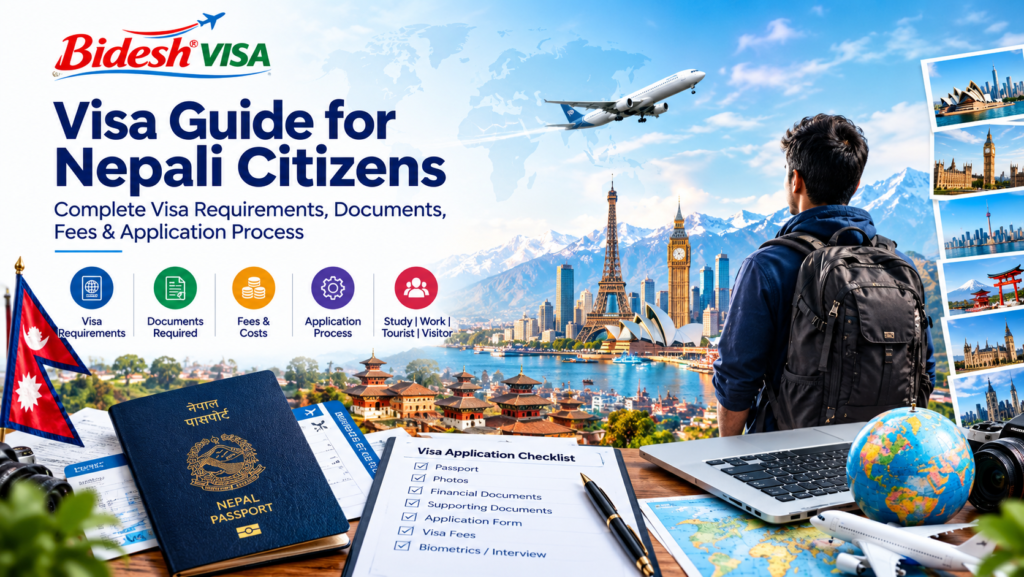
Visa Guide for Nepali Citizens featuring Bidesh VISA, Nepal passport, visa application documents, fees, requirements and international travel
Uncategorized

Visa Guide for Nepali Citizens: Complete Visa Requirements, Documents, Fees, Eligibility & Application Process.

Visa Guide for Nepali Citizens: Understanding Visa Types If you are a Nepali citizen planning to travel abroad for study, work, tourism, business, family visits, or transit, understanding the correct visa process is one of the most important parts of your travel preparation. Visa requirements are not the same for every country. The required documents, application procedures, financial requirements, visa fees, processing times, and eligibility conditions depend on the destination country, visa category, purpose of travel, duration of stay, and individual circumstances. This Visa Guide for Nepali Citizens provides a practical overview of the major visa types, commonly required documents, financial evidence, application process, interviews, possible refusal reasons, Nepal’s departure requirements, and country-specific information. Important: Immigration rules and visa fees can change. Always verify the latest requirements with the destination country’s official immigration authority, embassy, consulate, or authorised visa application centre before submitting an application. What Is a Visa? A visa is an authorisation or permission issued by a country’s competent authority that allows a foreign national to travel to that country for a particular purpose and under specified conditions. Depending on the country, a visa may be issued as a physical document, passport sticker, electronic visa, electronic travel authorisation, or digital immigration record. A visa also does not necessarily guarantee admission at the border. The destination country’s immigration officers may make the final decision on whether a traveller is admitted according to the country’s immigration laws and entry requirements. For this reason, Nepali travellers should understand the difference between: Visa approval Permission to travel Airline check-in Nepal departure clearance Border admission Length of authorised stay Visa conditions Visa Types for Nepali Citizens The correct visa depends mainly on the purpose of travel. 1. Study Visa A study visa is designed for students who intend to study at an educational institution abroad. Depending on the destination, applicants may need: Admission or offer letter Enrollment confirmation Academic certificates Academic transcripts Proof of tuition payment Financial evidence Passport Photographs Language test results where required Health or medical documents Police certificates where required Sponsorship documents Other immigration forms Students should check both the educational institution’s requirements and the immigration authority’s requirements. 2. Work Visa A work visa or work authorization allows an eligible foreign national to work under the conditions established by the destination country. Common requirements may include: Job offer Employment contract Employer sponsorship Employer nomination or approval Professional qualifications Relevant work experience Police clearance Medical examination Passport Biometrics Financial evidence where required A tourist or visitor visa should not be used for employment unless the destination’s immigration rules specifically permit the proposed activity. 3. Tourist Visa A tourist visa generally allows temporary travel for purposes such as: Holiday Sightseeing Recreation Visiting attractions Short-term tourism Applicants may need to demonstrate their travel purpose, financial circumstances, accommodation arrangements, and compliance with the intended temporary stay. 4. Visitor Visa A visitor visa may be used for visiting family or friends or other permitted temporary activities. The exact definition varies by country. Some countries use a single visitor category for tourism and family visits, while others have different categories. 5. Business Visa Business visas may permit certain short-term activities such as: Business meetings Conferences Negotiations Trade events Professional discussions A business visa does not automatically provide permission to undertake ordinary employment. 6. Transit Visa A transit visa may be required when passing through another country while travelling to a third country. Whether a Nepali citizen needs a transit visa depends on factors such as: Transit airport Connecting flight Airport transit area Destination Passport nationality Length of transit Whether the traveller changes airports Always check transit requirements before booking flights. Visa Requirements for Nepali Citizens There is no single universal visa requirement for every Nepali citizen. Each destination establishes its own eligibility criteria and documentation requirements. However, many visa applications commonly require some combination of: Valid Nepali passport Completed visa application Passport photographs Proof of travel purpose Financial documents Accommodation information Travel itinerary Employment or business evidence Academic documents Sponsorship documents where applicable Previous travel or immigration records Medical documents where required Police certificates where required Biometrics Visa application fee The most important step is identifying the correct visa category before collecting documents. Visa Documents for Nepali Citizens The exact visa documents depend on the destination and visa type. Identity Documents Common identity documents include: Current passport Previous passport where relevant Passport photographs Citizenship or other identity documents where requested Birth certificate where applicable Marriage certificate or relationship documents where relevant Check that your name, date of birth, passport number, and other personal information are consistent across documents. Purpose-of-Travel Documents Your documents should support the purpose stated in your application. For students Offer letter Enrollment confirmation Academic certificates Transcripts Tuition documents Scholarship documents where applicable For workers Job offer Employment contract Employer sponsorship documents Professional certificates Work experience evidence For tourists Travel itinerary Accommodation details Return or onward travel evidence where relevant Employment or business evidence Financial evidence For family visitors Invitation letter where required Proof of relationship Host’s immigration status where applicable Accommodation information Financial Requirements and Bank Documents Financial evidence is an important component of many visa applications. Applicants may be asked to demonstrate that they have sufficient funds for expenses such as: Transportation Accommodation Tuition Living expenses Health insurance Daily expenses Return or onward travel Depending on the destination, financial documents may include: Bank statements Bank balance certificates Salary certificates Salary slips Employment letters Tax documents Business income records Scholarship evidence Education loans Sponsor’s financial documents There is no universal bank-balance requirement for Nepali citizens. The required amount depends on the destination, visa category, duration of stay, tuition, accommodation, family circumstances, and other factors. Applicants should never create artificial financial transactions merely to make their bank statement appear stronger. Financial evidence should accurately represent the applicant’s genuine circumstances. Study Visa Requirements for Nepali Students For Nepali students, a study visa application normally involves three major areas: academic eligibility, financial capacity, and immigration eligibility. Students may need: Valid passport University or college admission

Scroll to Top