
Visa Guide for Nepali Citizens: Understanding Visa Types
If you are a Nepali citizen planning to travel abroad for study, work, tourism, business, family visits, or transit, understanding the correct visa process is one of the most important parts of your travel preparation.
Visa requirements are not the same for every country. The required documents, application procedures, financial requirements, visa fees, processing times, and eligibility conditions depend on the destination country, visa category, purpose of travel, duration of stay, and individual circumstances.
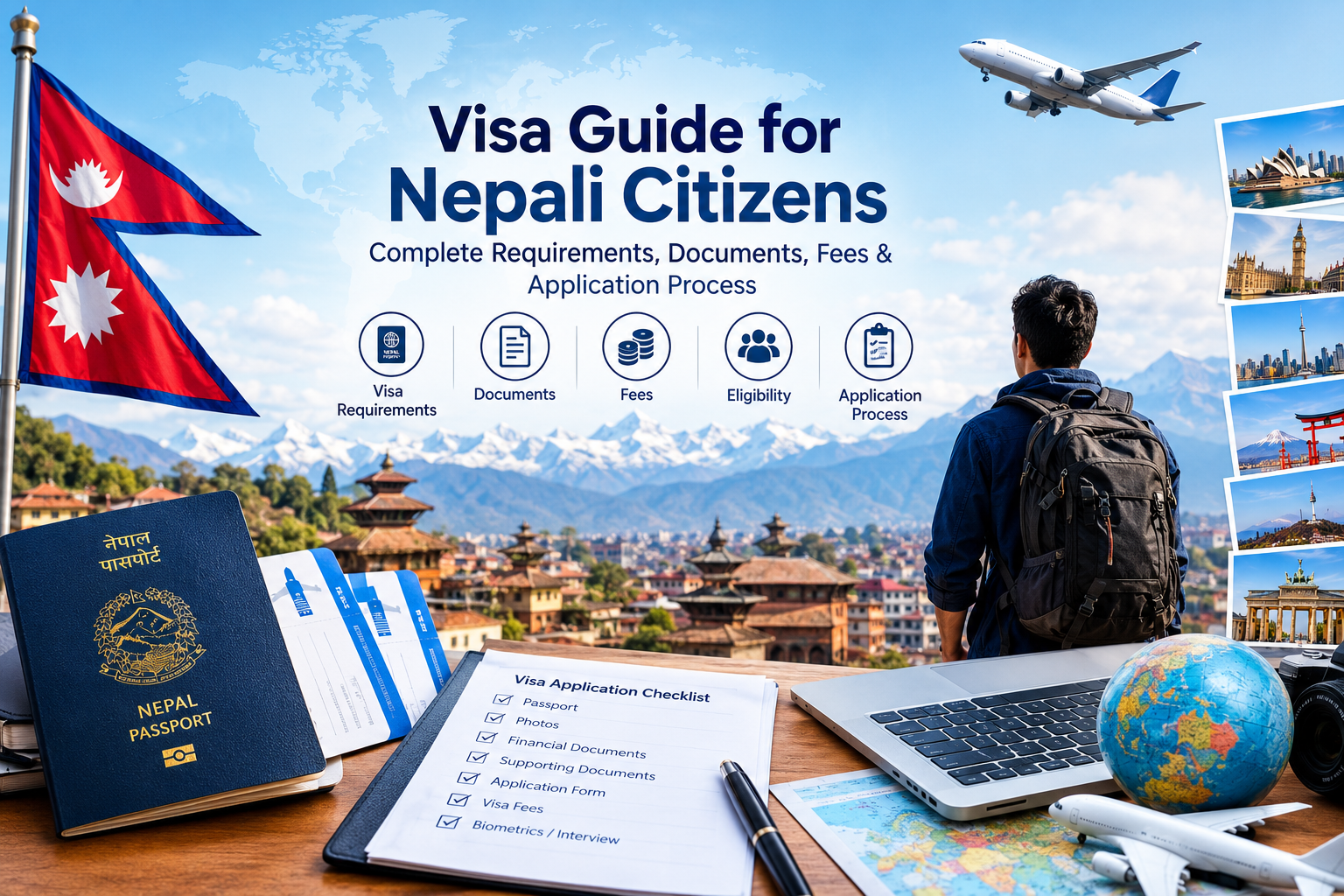
This Visa Guide for Nepali Citizens provides a practical overview of the major visa types, commonly required documents, financial evidence, application process, interviews, possible refusal reasons, Nepal’s departure requirements, and country-specific information.
Important: Immigration rules and visa fees can change. Always verify the latest requirements with the destination country’s official immigration authority, embassy, consulate, or authorised visa application centre before submitting an application.
What Is a Visa?
A visa is an authorisation or permission issued by a country’s competent authority that allows a foreign national to travel to that country for a particular purpose and under specified conditions.
Depending on the country, a visa may be issued as a physical document, passport sticker, electronic visa, electronic travel authorisation, or digital immigration record.
A visa also does not necessarily guarantee admission at the border. The destination country’s immigration officers may make the final decision on whether a traveller is admitted according to the country’s immigration laws and entry requirements.
For this reason, Nepali travellers should understand the difference between:
- Visa approval
- Permission to travel
- Airline check-in
- Nepal departure clearance
- Border admission
- Length of authorised stay
- Visa conditions
Visa Types for Nepali Citizens
The correct visa depends mainly on the purpose of travel.
1. Study Visa
A study visa is designed for students who intend to study at an educational institution abroad.
Depending on the destination, applicants may need:
- Admission or offer letter
- Enrollment confirmation
- Academic certificates
- Academic transcripts
- Proof of tuition payment
- Financial evidence
- Passport
- Photographs
- Language test results where required
- Health or medical documents
- Police certificates where required
- Sponsorship documents
- Other immigration forms
Students should check both the educational institution’s requirements and the immigration authority’s requirements.
2. Work Visa
A work visa or work authorization allows an eligible foreign national to work under the conditions established by the destination country.
Common requirements may include:
- Job offer
- Employment contract
- Employer sponsorship
- Employer nomination or approval
- Professional qualifications
- Relevant work experience
- Police clearance
- Medical examination
- Passport
- Biometrics
- Financial evidence where required
A tourist or visitor visa should not be used for employment unless the destination’s immigration rules specifically permit the proposed activity.
3. Tourist Visa
A tourist visa generally allows temporary travel for purposes such as:
- Holiday
- Sightseeing
- Recreation
- Visiting attractions
- Short-term tourism
Applicants may need to demonstrate their travel purpose, financial circumstances, accommodation arrangements, and compliance with the intended temporary stay.
4. Visitor Visa
A visitor visa may be used for visiting family or friends or other permitted temporary activities.
The exact definition varies by country. Some countries use a single visitor category for tourism and family visits, while others have different categories.
5. Business Visa
Business visas may permit certain short-term activities such as:
- Business meetings
- Conferences
- Negotiations
- Trade events
- Professional discussions
A business visa does not automatically provide permission to undertake ordinary employment.
6. Transit Visa
A transit visa may be required when passing through another country while travelling to a third country.
Whether a Nepali citizen needs a transit visa depends on factors such as:
- Transit airport
- Connecting flight
- Airport transit area
- Destination
- Passport nationality
- Length of transit
- Whether the traveller changes airports
Always check transit requirements before booking flights.
Visa Requirements for Nepali Citizens
There is no single universal visa requirement for every Nepali citizen.
Each destination establishes its own eligibility criteria and documentation requirements.
However, many visa applications commonly require some combination of:
- Valid Nepali passport
- Completed visa application
- Passport photographs
- Proof of travel purpose
- Financial documents
- Accommodation information
- Travel itinerary
- Employment or business evidence
- Academic documents
- Sponsorship documents where applicable
- Previous travel or immigration records
- Medical documents where required
- Police certificates where required
- Biometrics
- Visa application fee
The most important step is identifying the correct visa category before collecting documents.
Visa Documents for Nepali Citizens
The exact visa documents depend on the destination and visa type.
Identity Documents
Common identity documents include:
- Current passport
- Previous passport where relevant
- Passport photographs
- Citizenship or other identity documents where requested
- Birth certificate where applicable
- Marriage certificate or relationship documents where relevant
Check that your name, date of birth, passport number, and other personal information are consistent across documents.
Purpose-of-Travel Documents
Your documents should support the purpose stated in your application.
For students
- Offer letter
- Enrollment confirmation
- Academic certificates
- Transcripts
- Tuition documents
- Scholarship documents where applicable
For workers
- Job offer
- Employment contract
- Employer sponsorship documents
- Professional certificates
- Work experience evidence
For tourists
- Travel itinerary
- Accommodation details
- Return or onward travel evidence where relevant
- Employment or business evidence
- Financial evidence
For family visitors
- Invitation letter where required
- Proof of relationship
- Host’s immigration status where applicable
- Accommodation information
Financial Requirements and Bank Documents
Financial evidence is an important component of many visa applications.
Applicants may be asked to demonstrate that they have sufficient funds for expenses such as:
- Transportation
- Accommodation
- Tuition
- Living expenses
- Health insurance
- Daily expenses
- Return or onward travel
Depending on the destination, financial documents may include:
- Bank statements
- Bank balance certificates
- Salary certificates
- Salary slips
- Employment letters
- Tax documents
- Business income records
- Scholarship evidence
- Education loans
- Sponsor’s financial documents
There is no universal bank-balance requirement for Nepali citizens. The required amount depends on the destination, visa category, duration of stay, tuition, accommodation, family circumstances, and other factors.
Applicants should never create artificial financial transactions merely to make their bank statement appear stronger. Financial evidence should accurately represent the applicant’s genuine circumstances.
Study Visa Requirements for Nepali Students
For Nepali students, a study visa application normally involves three major areas: academic eligibility, financial capacity, and immigration eligibility.
Students may need:
- Valid passport
- University or college admission letter
- Academic certificates
- Academic transcripts
- Language test results where required
- Financial evidence
- Tuition payment evidence where applicable
- Accommodation information
- Health insurance where required
- Medical examination
- Police clearance where required
- Biometrics
- NOC or other Nepal-specific documentation where applicable
The exact requirements vary between countries.
Students should also make sure that their intended course, educational background, financial evidence, and application information are consistent.
NOC for Nepali Students
The No Objection Certificate (NOC) is an important consideration for Nepali students planning to study abroad.
Nepal’s Ministry of Education, Science and Technology provides information and services concerning NOC for Nepali citizens going abroad for education. The Ministry’s official information states that Nepali citizens going abroad to study at educational institutions are subject to the applicable NOC requirements.
Students should verify the current NOC procedure directly through the relevant Government of Nepal authority because requirements and procedures can change.
An NOC should not be confused with the destination country’s student visa. They are separate requirements administered by different authorities.
Work Visa Requirements for Nepali Citizens
The work visa process generally begins with an eligible employment opportunity.
Depending on the destination, the process may include:
- Finding an eligible employer.
- Receiving a genuine job offer.
- Obtaining employer sponsorship or nomination where required.
- Meeting occupational and qualification requirements.
- Preparing employment and personal documents.
- Submitting the immigration application.
- Providing biometrics.
- Completing medical or police checks if required.
- Paying applicable fees.
- Waiting for the immigration decision.
Nepali citizens travelling abroad for foreign employment may also have to comply with Nepal’s labour and departure requirements.
The Tribhuvan International Airport Immigration Office states that Nepali citizens travelling for foreign employment should have a valid passport and visa, boarding pass, and a Government of Nepal-issued labour permit.
Tourist and Visitor Visa Requirements
For tourist and visitor applications, immigration authorities commonly examine whether the applicant meets the requirements for temporary travel.
Supporting evidence can include:
- Valid passport
- Completed application
- Travel itinerary
- Accommodation information
- Financial evidence
- Employment or business evidence
- Invitation letter where applicable
- Proof of relationship where relevant
- Return or onward travel evidence where required
- Travel insurance where required
The applicant should demonstrate the genuine purpose of the trip and comply with the conditions of the intended visa.
Visa Fees for Nepali Citizens
Visa fees are determined by the destination country and specific visa category.
There is no single visa fee for Nepali citizens that applies worldwide.
Additional costs can include:
- Visa application centre charges
- Biometrics
- Medical examination
- Police certificate
- Translation
- Document certification
- Courier
- Travel insurance
- Priority processing
- Currency or payment-related charges
For example, the UK provides an official fee system based on the country where the application is made and the visa category. Its published fee information for Nepal shows different charges for visitor, study, transit, work, and other categories.
Australia similarly states that visa application charges can change and provides an official visa pricing system for checking the applicable fee.
Therefore, applicants should check the official fee immediately before submitting their application.
Visa Application Process from Nepal
The general visa application process in Nepal can be divided into the following steps.
Step 1: Choose the Correct Visa
First determine whether you are travelling for:
- Study
- Work
- Tourism
- Family visit
- Business
- Transit
- Another permitted purpose
Step 2: Check Official Eligibility
Visit the official immigration website or embassy/consulate website of the destination country.
Check the requirements for the exact visa category.
Step 3: Prepare Documents
Collect the required identity, financial, academic, employment, travel, sponsorship, and supporting documents.
Step 4: Complete the Application
Complete the official application carefully.
Check:
- Name spelling
- Passport number
- Date of birth
- Travel dates
- Previous travel
- Employment
- Education
- Family information
Incorrect or inconsistent information can create problems.
Step 5: Pay the Visa Fee
Pay the applicable visa application charge through the official application system or authorized provider.
Step 6: Submit Biometrics
If biometrics are required, attend the designated appointment.
Step 7: Complete Additional Requirements
Some applicants may need:
- Medical examination
- Police certificate
- Interview
- Additional documents
- Translation
- Document verification
Step 8: Wait for the Decision
Processing times differ between countries and visa categories.
Avoid relying on unofficial promises of guaranteed approval or guaranteed processing times.
Step 9: Check Your Visa
After approval, carefully verify:
- Name
- Passport number
- Visa category
- Validity
- Entry conditions
- Number of entries
- Permitted stay
- Other visa conditions
Biometrics and Visa Interview
Some countries require applicants to provide biometric information such as fingerprints and photographs.
A visa interview, when required, may ask about:
- Purpose of travel
- Study plans
- Employment
- Financial situation
- Accommodation
- Travel history
- Sponsor
- Family circumstances
- Intended duration
Common visa interview questions can include:
- Why are you travelling?
- Why did you choose this country?
- Who will finance your trip?
- Where will you stay?
- What do you do in Nepal?
- How long will you stay?
- What are your study or employment plans?
Applicants should answer honestly, clearly, and consistently with their submitted documents.
Common Visa Rejection Reasons
Visa refusal depends on the specific country and visa category. Potential issues can include:
- Failure to meet eligibility requirements
- Insufficient supporting evidence
- Incomplete application
- Inconsistent information
- Unclear financial circumstances
- Failure to establish the required purpose
- Failure to satisfy specific visa conditions
- Misrepresentation or false information
- Missing required documents
- Failure to meet health or character requirements where applicable
A refusal letter should be reviewed carefully because it normally explains the relevant grounds for the decision.
If a new application is permitted, the applicant should address the issues identified by the immigration authority rather than simply submitting the same application again.
What to Do After Visa Approval
Visa approval does not mean that preparation is finished.
Before travelling, check:
- Passport validity
- Visa validity
- Entry requirements
- Permitted length of stay
- Number of entries
- Accommodation
- Flight arrangements
- Travel insurance where required
- Financial arrangements
- Supporting documents
Keep important documents accessible during your journey.
A visa generally allows a traveller to seek entry; the destination’s border authorities can still conduct immigration checks and determine admission according to applicable law.
Nepal Pre-Departure and Airport Checklist
Nepali citizens leaving Nepal must also meet applicable departure requirements.
The Tribhuvan International Airport Immigration Office states that passengers departing Nepal must pass immigration checks and present a valid passport and required travel documentation.
Depending on the purpose of travel, additional documentation may be required.
General checklist
- Valid passport
- Valid visa
- Boarding pass
- Flight details
- Accommodation information
- Financial evidence where relevant
- Sponsor documents where applicable
- Invitation letter where relevant
- NOC for applicable students
- Labour permit for applicable foreign-employment travellers
- Academic documents for students
- Copies of important documents
For foreign employment, the airport immigration guidance specifically lists a valid passport and visa, boarding pass, and Government of Nepal labour permit.
Country-Specific Visa Requirements
Visa requirements must ultimately be checked according to the destination.
Australia
Nepali applicants should check the Australian Department of Home Affairs for the appropriate visitor, student, work, or other visa category. Australia provides an official pricing system because visa charges vary according to the visa type and circumstances.
Canada
Applicants should use the Government of Canada’s official immigration resources for visitor, study, work, family, and other immigration categories.
United Kingdom
UK visa requirements differ according to the immigration route. Applicants can use the official GOV.UK visa service and fee tools to identify the appropriate category and current charges.
United States
Applicants should consult the U.S. Department of State and the U.S. Embassy responsible for Nepal for the appropriate nonimmigrant or immigrant visa requirements.
Japan
Visa requirements depend on the purpose and duration of travel. Nepali applicants should consult the official Japanese diplomatic or consular information applicable to Nepal.
South Korea
Requirements depend on the relevant visa classification and intended activity. Applicants should check current information from the appropriate Korean diplomatic and immigration authorities.
Germany
Applicants should consult the German Embassy or other official German immigration resources for study, employment, tourism, family reunification, and other visa categories.
Other Countries
For any other destination, use the destination country’s official immigration authority, embassy, consulate, or authorized application centre as the primary source.
What is the main visa requirement for Nepali citizens?
There is no universal requirement. The applicant must meet the eligibility and documentation requirements of the destination country and specific visa category.
How much bank balance is required for a visa from Nepal?
There is no universal amount. Financial requirements vary according to the destination, visa type, duration, and individual circumstances.
Do Nepali students need an NOC?
Nepali students travelling abroad for education should check the current NOC requirements of the Government of Nepal. The applicable requirements depend on the circumstances and current regulations.
Can I apply for a visa online from Nepal?
Yes, many countries provide online applications. However, some applications also require biometrics, interviews, or document submission at an embassy, consulate, or authorized visa application centre.
Does a visa guarantee entry?
No. A visa generally permits a traveller to seek entry, but border authorities may conduct their own immigration assessment.
How long does visa processing take?
Processing times vary according to the country, visa category, application volume, season, and individual circumstances. Always check the official processing-time information.
Can I work on a tourist visa?
Generally, a tourist or visitor visa does not authorise ordinary employment. The applicant must follow the destination country’s rules concerning permitted activities.
Official Sources and Visa Information
For accurate international visa information for Nepali citizens, official government sources should be treated as the primary reference.
Useful sources include:
- Destination country’s immigration authority
- Destination country’s embassy or consulate
- Official government visa portal
- Authorized visa application centre
- Nepal Department of Immigration
- Ministry of Education, Science and Technology
- Relevant Nepal labour authorities
The Tribhuvan International Airport Immigration Office provides official departure information for Nepali travellers, including specific requirements for foreign employment and other travel purposes.
For students, the relevant Government of Nepal education authorities should be consulted for current NOC procedures.
Conclusion
Applying for a visa from Nepal requires careful preparation and accurate information. Whether you are planning to study abroad, work overseas, visit family, travel for tourism, attend business activities, or transit through another country, the first step is to identify the correct visa category.
A successful application generally requires applicants to understand the destination’s eligibility rules, prepare genuine and relevant documents, demonstrate their financial circumstances where required, complete the application accurately, provide biometrics or attend an interview when required, and pay the applicable fees.
Most importantly, there is no universal visa requirement, bank-balance requirement, processing time, or visa fee for all Nepali citizens. Requirements depend on the country, visa category, and applicant’s circumstances.
Always verify current information through the relevant official immigration authority before applying or travelling. Rules can change, and information published by unofficial websites or social media may become outdated.
For Nepali citizens planning international travel, this Visa Guide for Nepali Citizens provides the foundation for understanding the visa process. Detailed country-specific guides should then be used to check the exact requirements for the destination and purpose of travel.